 >
> 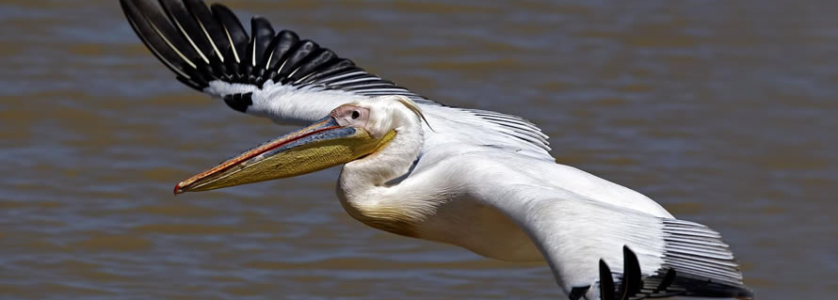
PELICANS IN UGANDA
Pelicans are a genus of large water birds that make up the family Pelecanidae. They are characterised by a long beak and a large throat pouch used for catching prey and draining water from...
View package
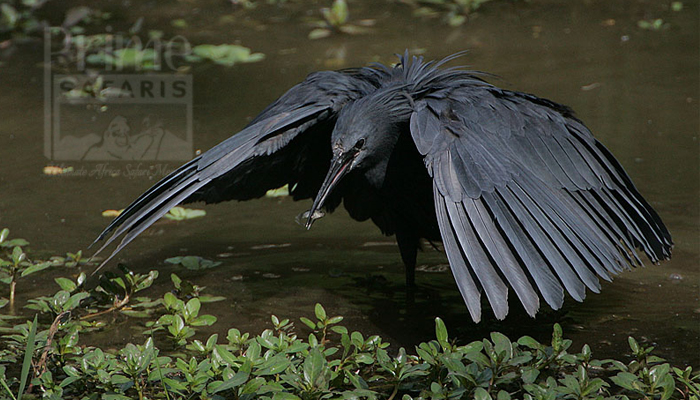
The Black Heron in Uganda is among the remarkable African bird species often encountered on birding tours in Uganda. Sightings like these make Uganda birding tours and birdwatching safaris truly rewarding, showcasing the rich diversity of birding in Uganda
The black heron falls under the pelecaniformes which is an order for the medium sized water birds ranging between 42 to 66 centimeteres in height. Binomially the bird species is referred to as Egretta ardesiaca and also sometimes known as the black egret. It has a black layer of feathers with yellowish colored legs and feet along with a black bill. This bird species is widely spread through the sub Saharan Africa from Sudan and Senegal to South Africa although it is basically found in Madagascar and on the eastern half of the continent. It also inhabits parts of Italy and Greece hence known for using its wings in the process of forming canopy while fishing.
This bird species is the darkest of the egrets having an overall layer of feathers with a grey-bluish gloss. The black egret features a shaggy crest on the head which is made of black, lanceolate feathers on the nape and the hind crown. It is characterised with the long and broad secondaries, scapulars, axillaries and lesser wing converts.
The bird is composed of the bright yellowish eyes comprising of the black bill and legs. An adult black heron has brightly orange feet that are conspicuous while at flight. Both bird species have similar sexes and during the beginning of the bleeding period the toes turn reddish in colour hence developing long plumes on the nape and crown. Juvenile species do have short feathers and features a browner along with duller colour.
The Black Egret is mainly known for its technical fishing method during the feeding process where it walks quickly or slowly within the shallow water hence spreading its wings and arching them forward and occassionally over its head. It does this frequently until the primary wing tips skims the water thereby resembling an umbrella floating over the water.
While fishing, the bird remains motionless state as it scrape its feet at the bottom of the mud in order to get the prey and this fishing method is done along the open shores, in shallow water and among the emerged vegetation together with the floating vegetation within the deeper waters.
The bird jabs its prey with a bill while hunting with wings that are umbrella-like closed and its feeds in groups though sometimes alone however it will always chase away birds of its race when preferring to feed alone. Black heron is a solitary and gregarious species which is occassionally seen forming flocks of about 50 birds that roost high up in reedbeds or trees in colonies which are mostly of mixed aquatic birds and mono-specific groups. This heron species is regularly seen shaking its layer of fathers strongly hence leaving the feathers to replace slowly.
In flight, the Black Heron draws back its neck with the pointed bill forward and the legs which are held backwards hence being similar to other Herons.
Black egret is a medium bird species weighing about 300 grams and having the maximum length ranging between 52 to 55 centimeters long. The bird is characterized with a broad and wide wingspan stretching over 90 to 95 centimeters.
However the bird species utter deep clucking sound which is similar to the heron’s call while fishing in flocks, it is mainly a silent bird which only gives a raucous call in defence of the nest. Black Heron inhabits a wide range in Madagascar, Africa, Cape Verde Islands, Israel and South of Sahara hence staying close to rivers, lakes, shallow freshwater, marshes and coastal mudflats.
During the reproduction process, the Black heron breeds in colonies of the same family. The adult male species constructs a nest which is made of stems and small branches and also decorated with leafy branches together with grass. The nest is always set up 6 meters above the water or ground and in trees which is a platform of about 26 to 35 centimeters in diameter.
Within this period, the adult breeding female lays a maximum of about 2 to 4 eggs which are always pale blue or greenish- blue. The incubation process is done by both parents lasting for a period of 14 to 30 days. After hatching, the chicks are covered with dark greyish down and a white downy crest at only one week of age. The young one is characterised with a greenish skin together with the yellowish underparts and throat. It also comprises of the dark brown eyes along with greenish yellow legs and feet. It also becomes darker having black legs at 2 weeks of age because this is when it develops black feathers around its body.


Robert
For top-notch safari guidance, contact us via phone or book a video conference with our expert advisors.