This Eurasian also is known as the Great Bittern, is a wading bird found within the Ardeidae or heron family and also classified into the bittern subfamily. The Eurasian Bittern bird is comprised of two subspecies including the Northern race which is endemic to parts of Europe and the Southern race has seen breeding in parts of Southern Africa.
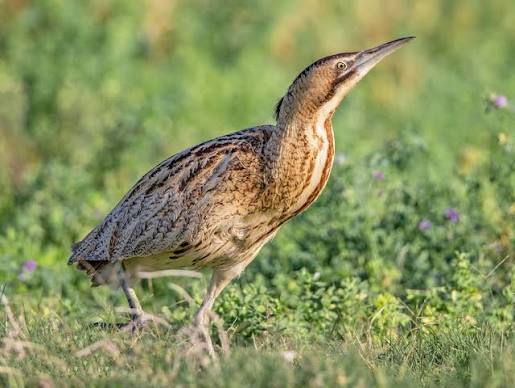
The Great Bittern is a secretive bird baring a Yellowish-brown layer of feathers on the upper parts combined with the mottled patches that are golden and black-streaked hence providing excellent camouflage.It constructs the nest at the edges of water bodies among the reeds. Due to the specific requirements of the habitat and the general reduction in wetlands across the globe, it is thought that the population of the species is in decline.
The bird species spends much of its hiding in aquatic dense vegetation and in reed-beds though feeding is done in open areas not so far from the cover where it can run into hiding if danger is sensed.
Physical description and Behaviour of the Great Bittern
Eurasian Bittern feeds on small mammals, amphibians, fish, insects, crustaceans and the fledgeling birds and it moves easily with its long feet while grabbing the reeds within the reed stems. The bird haslong toes which allow it to climb and also stabilises while walking on floating vegetation and the construction of the nest is done on the shores of the water bodies in the reeds
The bird species adopt different postures depending on its moment and it fluffs its layer of feathers and deeps its neck hence becoming big as an egg. Great Bittern will develop an erect posture if disturbed within the reeds and will withheld neck, head and the bill upwards.
It has palerunderparts which are vertically dark-streaked and also having a reddish-brown flank, breast and belly. Great Bittern is composed of a pale Yellowish-brown throat and also has a black nape crownedhead having a black moustache which starts from the bill base proceeding down the head sides.
Male and female Eurasian Bitterns are similar with the juvenile resembling the adults baring a moustache with streaked brown crown, paler wings and a less marked mantle.
During the breeding process, the incubation of the laid clutch of eggs is only done by a female including the feeding of young chicks. After incubation, the chicks will leave the nest in a period of two weeks and the adult female will still care for the chicks until they fully develop the wings and feathers that are large enough for a flight to occur. Fledging will happen in a period of six weeks after the hatching process has occurred.
Great Bittern outside the breeding season is a solitary bird species and if alarmed it may attack. It is a perfect defender and protects a large part of the nest or reedbed against other adult males. Due to the aggressiveness of the males, it leads them to fight strongly with mortal peaks and they open their wings in front of the opponents as they fluff the shoulder’s long feathers and neck.
After the species has killed any prey, it cleans its feathers or plumage because the killed prey leaves behind the mucus on the bird’s feathers. While in the cleaning process, the Eurasian bittern will rub its neck and head under its shoulders for about 35 seconds and then will preen the plumage to remove mucus and dust and the process lasting up to 45 minutes while performing it different times in a day.
The Great Bittern while in flight it rises in an awkward and careless way that lacks skills with an extended neck and flying low for a short period over the reeds or nest before it goes back into the cover. As it flies high, it retracts the neck as it is in other species mostly the herons.
Reproduction process of the Eurasian Bittern
The female adult during the reproduction process in the early March, it will lay a maximum of about four to six eggs that are greenish-brown in colour and also spotted with brown within the period of two to three days. After the laying of eggs has happened, the incubation process will begin with the first-ever laid egg. This incubation process is only done by the female and it will last for about 26 days and the chicks are covered with the brown-reddish down. Young ones are only fed with regurgitating of food into the nest and it is done by the female adult because males are always polygamous.
The chicks will begin leaving the nest and move around the vegetation in the surrounding area in the period of about 2 to 3 weeks. They develop the layer of feathers when they are 8 weeks old and are able to fly throughout July and within this period of fledge, they are able to look after themselves by finding their own food and also in a period of one year, they are able to reach their sexual maturity.
 >
>